


Bolivian Organizations Denounce Removal of teleSUR from Broadcasts as Censorship
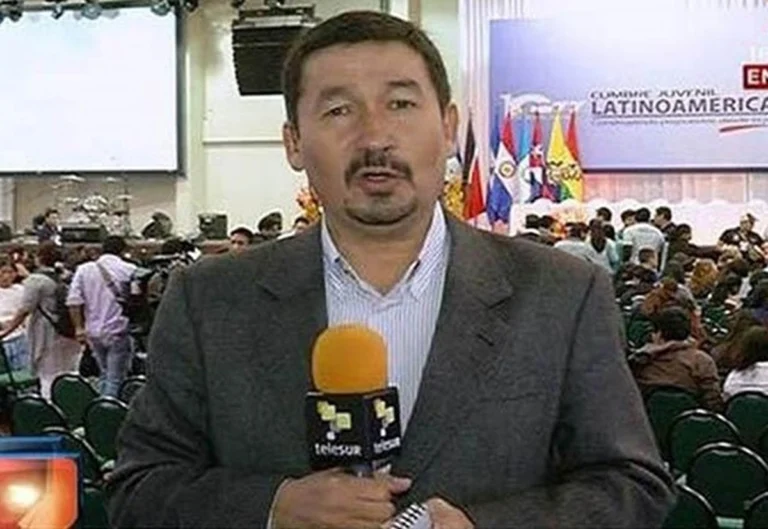
teleSUR correspondent in Bolivia, Freddy Morales. Photo: Bolivia Prensa.
January 19, 2026 Hour: 2:30 pm
The diversity of political voices is protected by the Bolivian Constitution.
On Monday, the International Press Correspondents Association (ACPI) and the Journalists of Bolivia National Association (ANPB) denounced the decision by the National Telecommunications Company (Entel) to remove teleSUR and Russia Today (RT) from its services as censorship.
RELATED:
President Paz Brings Shock Policies Back to Bolivia
They questioned the measure, as the “administrative” arguments offered are insufficient and lack transparency. ACPI and ANPB warned that the lack of explanation violates the rights of audiences to diverse information and raises suspicions of a political act that restricts freedom of expression.
Previously, similar decisions in Bolivia and other countries have weakened democratic debate, even when the diversity of political voices is a fundamental pillar protected by the Bolivian Constitution.
The arbitrary silencing of media outlets will normalize censorship practices that are difficult to reverse, which exposes journalists to greater restrictions in the future if they do not align with official discourses.
ACPI and ANPB urged the Bolivian government to guarantee freedom of expression and the right of citizens to be informed through the media they freely choose, without ideological or political discrimination.
The text reads, “Bolivia’s state-owned telecommunications company, ENTEL, under the new management of President Rodrigo Paz’s right-wing government, a new pawn of the empire, has removed teleSUR and Russia Today from its broadcasts. However, this lack of media pluralism will receive little attention.”
The Alternative Media of Bolivia Association (AMAB) joined in the rejection, recalling that even in previous administrations of different political orientations, international channels such as CNN have broadcast without restrictions.
AMAB described the exclusion of teleSUR and RT as a direct attack on the right of Bolivians to be diversely informed. The organization emphasized that access to multiple sources of information is a right in a democratic state.
It also warned that Entel’s decision is not a technical or commercial adjustment, but a political measure that deliberately restricts access to viewpoints different from those promoted by the government.
TeleSUR President Patricia Villegas called the decision “as predictable as it is reprehensible” and assured that the outlet will continue to support the Latin American people in their right to information.
Previously, Entel had terminated its contract with teleSUR in November 2019, during the government of Interim President Jeanine Añez, initially citing “technical problems” and later “a reorganization of the channel lineup.”
teleSUR: JP
Source: teleSUR